

 0
0
 0
0
We needed a reliable SMS verification backend for a SaaS product. Tested six services over two months, built API integrations for three of them, and threw the rest away. Here is what survived.
Some context before the breakdown. Our three-person dev team runs a social media management tool. Part of what the product does is help clients spin up regional accounts on platforms like Instagram, TikTok, and Facebook for geo-targeted campaigns. Every new account needs phone verification, and those verifications need to happen programmatically – not through a web dashboard with manual clicking.
For two years, the backbone of this workflow was SMS-Activate. The API was solid, documentation was decent, and the pricing made sense at scale. When SMS-Activate shut down in December 2025, it did not just remove a tool – it broke a production pipeline that handled 200+ verifications per week.
Finding the top SMS activate services in 2026 was not about reading review articles. It was about rebuilding a critical piece of infrastructure. Speed mattered, API quality mattered, and number reliability mattered more than everything else combined.
What We Were Looking For
Not every SMS activation platform works for automated workflows. A pretty web UI is irrelevant when the entire interaction happens through API calls. Our requirements were specific:
Well-documented REST API. Needs to support the full lifecycle: request a number, get the phone number back, poll for the SMS, retrieve the code, mark as complete or cancel. If any of these steps require manual intervention, the service is useless for automation.
Consistent delivery. A 70% success rate might work for someone doing five activations a month by hand. When an automated system fires 30-40 requests in an hour, even a 90% success rate means 3-4 failures per batch that need retry logic, error handling, and cost tracking. Anything below 95% creates more engineering work than it saves.
Geographic coverage. The product supports clients in North America, Europe, Southeast Asia, and Latin America. A service covering only 30-40 countries would leave gaps that need to be filled by a second or third provider.
No charge for failed deliveries. At scale, paying for numbers that never receive a code is an invisible budget drain. Automatic refunds for undelivered SMS are essential.
Here is how the top contenders performed against these requirements.
1. HeroSMS
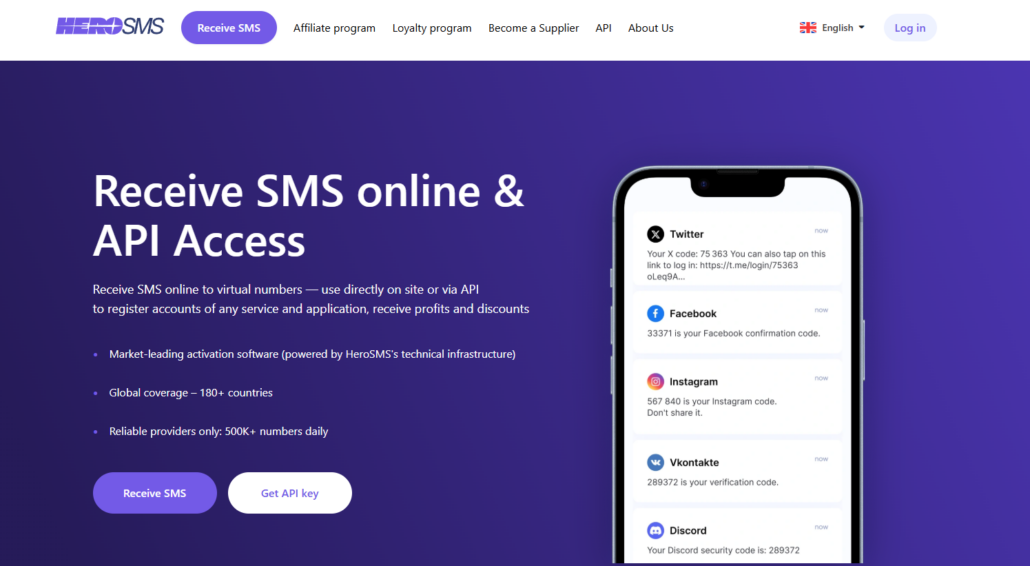
Site: hero-sms.com API docs: hero-sms.com/api
This is where the SMS-Activate story continues. Before shutting down, SMS-Activate published a Q&A on their farewell page. When asked where users should buy numbers going forward, they named HeroSMS and explained that they had handed their technology to the HeroSMS team. They also warned that any other service using the SMS-Activate name is a scam.
That tech transfer is not just a marketing talking point. It showed up concretely when we started the API integration.
API migration from SMS-Activate:
The HeroSMS API follows the same structure as the old SMS-Activate API. Same endpoint logic, same request parameters, same response format for the key operations – getNumber, getStatus, setStatus. Our existing Python automation script required three changes:
- Swapped the base URL.
- Replaced the API key.
- Updated one status code mapping that had a minor difference.
Total migration time: about 30 minutes, including testing. For any team that had a working SMS-Activate integration, the switch is essentially a find-and-replace operation.
Performance over two months (January-March 2026):
- Activations attempted via API: 487.
- Successful deliveries: 476.
- Failed (no SMS within 20-min window): 11.
- Success rate: 97.7%.
- Average delivery time: 18-22 seconds.
- Automatic refunds for all 11 failures: yes, no tickets needed.
Pricing at our volume:
Most of our activations cluster around Instagram ($0.015), Google ($0.02), Facebook ($0.02), and WhatsApp ($0.15). Blended average across all services and countries landed around $0.05 per activation.
The five-tier loyalty discount system helped push costs down starting in the second month. The tiers are based on cumulative top-up amounts, scaling up to 40% off at the highest level. At our usage level, we are in the second tier, which shaves a few percent off.
Payment options include crypto, bank cards, bank transfer, and E-Wallet — which covers most preferences including business accounting workflows.
Coverage: 180+ countries, 700+ pre-configured services, “Any Other” option for unlisted platforms. We have used numbers from 14 different countries without stock issues.
What we do not love:
No webhook support for SMS delivery. The API uses polling – our script checks getStatus every 3-5 seconds until the code arrives or times out. A push-based webhook would reduce API calls and speed up the pipeline. Not a dealbreaker, but a nice-to-have for high-volume operations.
No number rental. Everything is one-time activation with a 20-minute window. Fine for verification flows, but it means a second provider is needed for any use case requiring persistent numbers.
2. 5SIM
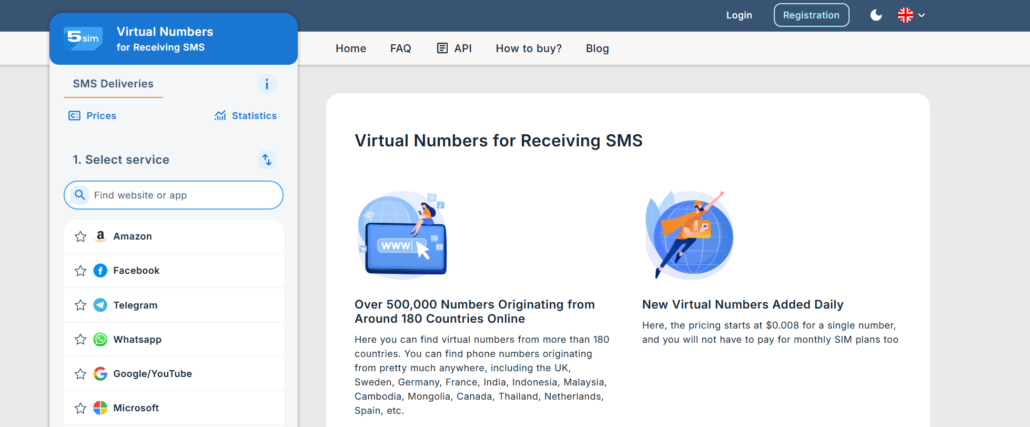
Site: 5sim.net API docs: 5sim.net/docs
5SIM was the first service we tested, mostly because of pricing. The starting rate of $0.008 per number is the lowest on the market, and the API documentation is reasonably thorough.
API quality:
The API is functional and well-structured. Endpoints for buying numbers, checking status, and finishing/canceling activations are all present. Documentation includes code examples in PHP and Python. Integration took about two hours from scratch.
One useful API feature: the pricing endpoint lets you query real-time prices and available number counts per country and operator before making a purchase. This is helpful for building retry logic – if stock is low for a country/operator combination, the script can automatically fall back to an alternative.
Performance:
- Activations attempted: 52.
- Successful deliveries: 38.
- Failed: 14.
- Success rate: 73%.
- Average delivery time (successful): about 35 seconds.
The 73% success rate is the reason 5SIM did not become the primary tool. For a manual workflow where a failed number just means clicking “try again,” this is manageable. For an automated pipeline processing batches, a 27% failure rate means building substantial retry and error-handling logic.
The failures were concentrated in specific regions: Southeast Asian numbers for messaging apps had the worst performance. US and European numbers for social media were more reliable, closer to 85-90%.
Pricing: effectively the cheapest. Even accounting for the retry cost (buying 1.3 numbers on average to get 1 successful delivery), the blended cost per successful activation was around $0.02-$0.03 for mainstream services.
What we liked: the real-time statistics page (also accessible via API) that shows success rates by country, operator, and service. Smart automation can use this data to pre-filter number selections and avoid known-bad combinations.
What we did not like: the inconsistency. At scale, unpredictability creates engineering overhead that outweighs price savings.
3. SMS-Man
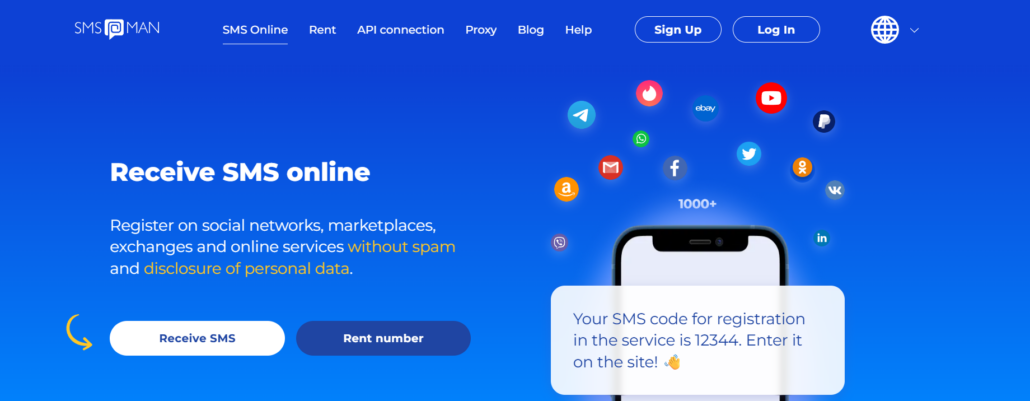
Site: sms-man.com
SMS-Man covers the widest catalog – 1,500+ services across 195 countries. The API exists and works, though the documentation is less polished than HeroSMS or 5SIM.
API quality:
Functional but with some quirks. The endpoint naming is slightly non-standard, and response formats required a bit more parsing work than expected. Integration took about three hours, including debugging a timezone issue in the activation status timestamps.
A Telegram bot is available as an alternative interface, which some users prefer for semi-automated workflows.
Performance:
- Activations attempted: 34.
- Successful deliveries: 27.
- Failed: 3 (no code received).
- Rejected by target platform: 4 (recycled numbers).
- Effective success rate: 79%.
- Average delivery time: 25-40 seconds.
The “rejected by target platform” category is the important distinction here. These are numbers where the SMS technically arrived, but the target service (WhatsApp, LINE) said the number was already used. In an automated pipeline, this looks like a success from the API’s perspective but a failure from the application’s perspective. Our script had to add a secondary validation step to catch these.
Pricing: starting around $0.05. Mid-range.
What makes it useful: the 1,500+ service catalog. When a client needs verification on a regional platform that nobody else supports – a local classifieds site, a country-specific payment app, a niche marketplace – SMS-Man usually has it. We keep it as a dedicated fallback for these edge cases.
What held it back: the recycled number problem. Building detection logic for “number accepted by API but rejected by target platform” added complexity to the automation pipeline.
4. TextVerified
Site: textverified.com
TextVerified is a specialist. US-based non-VoIP numbers only. Prices start at $0.25 per SMS – roughly 10x more than budget platforms.
API quality:
Clean REST API with solid documentation. Integration was straightforward – about 90 minutes. The API supports both SMS and voice verification, which is a nice feature for platforms that offer call-based OTP as an alternative.
Performance:
- Activations attempted: 14 (US numbers only).
- Successful deliveries: 14.
- Success rate: 100%.
- Average delivery time: 12-15 seconds.
The 100% success rate, including on platforms that typically reject virtual numbers (Tinder, Cash App), is the entire value proposition. Non-VoIP numbers from real US carriers behave identically to regular phone numbers from the platform’s perspective.
Pricing: $0.25-$1.00 per activation depending on the target service. Rentals from $1.50/day.
How we use it: reserved exclusively for US services that reject numbers from other providers. Maybe 5-10 activations per month. At that volume, the premium is justified by the 100% acceptance rate.
Limitation: US-only. No international numbers.
5. OnlineSIM
Site: onlinesim.io
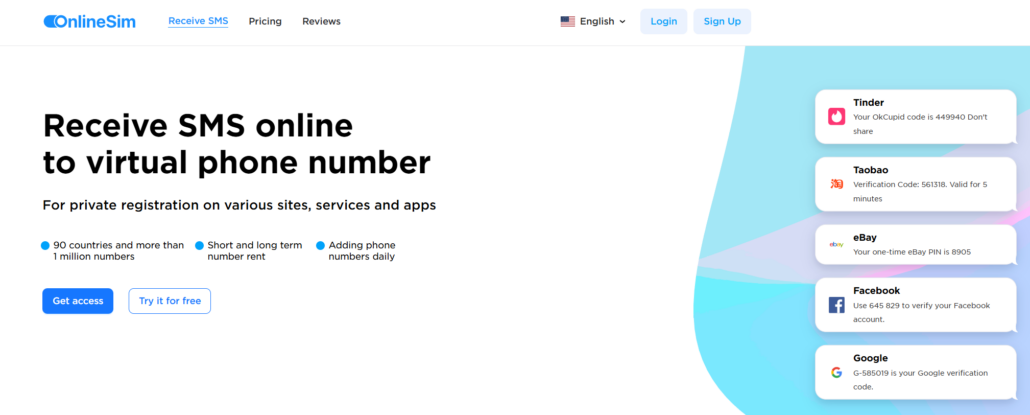
OnlineSIM has operated since 2013 and offers both one-time activations (from $0.01) and number rentals (from $3/day). The rental feature is unique in this comparison.
API quality:
The API covers both activation and rental workflows. Documentation is adequate, with examples in several languages. Integration was about two hours.
Performance:
- Activations attempted: 18.
- Successful deliveries: 15.
- Success rate: 83%.
- Average delivery time: 30-45 seconds.
Solid but not exceptional. The narrower coverage (90+ countries versus 180+ on HeroSMS and 5SIM) was the main limitation for our multi-region use case. European and US numbers performed well. Southeast Asian and Latin American coverage had gaps.
What makes it valuable: the rental option. For accounts where we need to receive 2FA codes periodically over days or weeks, buying a one-time activation does not work. OnlineSIM’s rental numbers fill this gap. We maintain 2-3 rental numbers at any given time for long-lived test accounts.
What held it back as a primary: the 90-country coverage and slightly lower success rate compared to HeroSMS.
6. Grizzly SMS
Site: grizzlysms.com
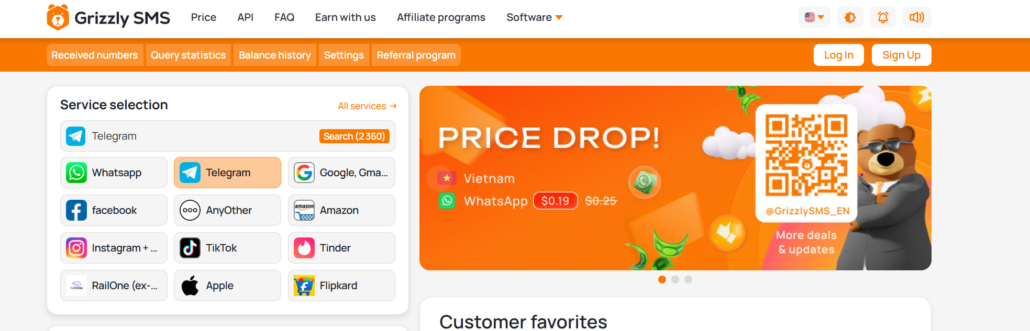
Grizzly SMS offers competitive pricing from $0.04, a modern interface, and claims 260+ countries. The company is registered in London and has a verifiable public profile.
API quality:
API documentation exists but is less comprehensive than the top options. Integration took longer than expected – about four hours, partly due to sparse error code documentation.
Performance:
- Activations attempted: 16.
- Successful deliveries: 13.
- Success rate: 81%.
- Average delivery time: 20-30 seconds.
Good delivery speed but inconsistent stock. Several API requests returned “no numbers available” for country/service combinations that showed stock on the web interface minutes earlier. The mismatch between web UI availability and API availability caused some confusion during integration.
What we liked: fast support response (under 15 minutes via live chat), clean interface for manual fallback operations, transparent pricing.
What held it back: the stock inconsistency via API and thinner documentation made it less suitable for a fully automated pipeline.
The Final Stack
After two months of parallel testing, the architecture settled into a tiered system:
Tier 1 – Primary provider (handles ~85% of volume): HeroSMS. Highest success rate, SMS-Activate API compatibility, broadest coverage for the price, automatic refunds. The 30-minute migration from our SMS-Activate scripts sealed the deal.
Tier 2 – Budget fallback (~10% of volume): 5SIM. When HeroSMS occasionally shows a higher price for a specific country/service combination, 5SIM’s lower pricing makes it worth the reduced success rate for cost-sensitive batches. The real-time statistics API helps the script pick smarter number/country combinations.
Tier 3 – Specialty use cases (~5% of volume):
- TextVerified for US non-VoIP numbers on platforms that reject everything else.
- OnlineSIM for number rentals on accounts needing persistent 2FA access.
- SMS-Man for niche or regional platforms not available elsewhere.
The automation script handles tier selection automatically based on the target service, country, and cost parameters. If Tier 1 fails twice on a specific combination, it drops to Tier 2. If the target service is flagged as “US non-VoIP only,” it routes directly to TextVerified.
What Matters and What Doesn’t
After processing 600+ activations across six platforms, a few things became clear about what separates the top SMS activate services in 2026 from the rest.
API compatibility with SMS-Activate matters more than most people realize. Tens of thousands of developers had scripts, bots, and automation tools built against the SMS-Activate API. Any platform that mirrors that API structure inherits a massive advantage. HeroSMS does this by design – which is not surprising given it runs on the same technical foundation.
Success rate compounds. The difference between 97% and 75% sounds like 22 percentage points. In practice, at 200 activations per week, the 75% service generates 50 failures. Each failure needs retry logic, costs money, and adds latency. The “cheaper” service ends up costing more in engineering time and failed-activation overhead than the “pricier” one.
Geographic coverage has diminishing returns. The jump from 90 countries to 180+ is significant. The jump from 180+ to 260+ is mostly marginal, because the additional countries often have thin stock and inconsistent delivery. For most use cases, 180+ countries with good reliability beats 260+ countries with spotty availability.
The SMS-Activate shutdown was a market correction, not an anomaly. Services in this niche can disappear. Building a pipeline around a single provider is a single point of failure. Multi-provider architecture with automated fallback is not over-engineering – it is operational hygiene.
Data in this article reflects testing from January through March 2026 across our production and staging environments. Prices, stock, and success rates fluctuate. Always verify current conditions directly on each platform.